DNS Monitoring
Resolution that works — and returns the records you expect.
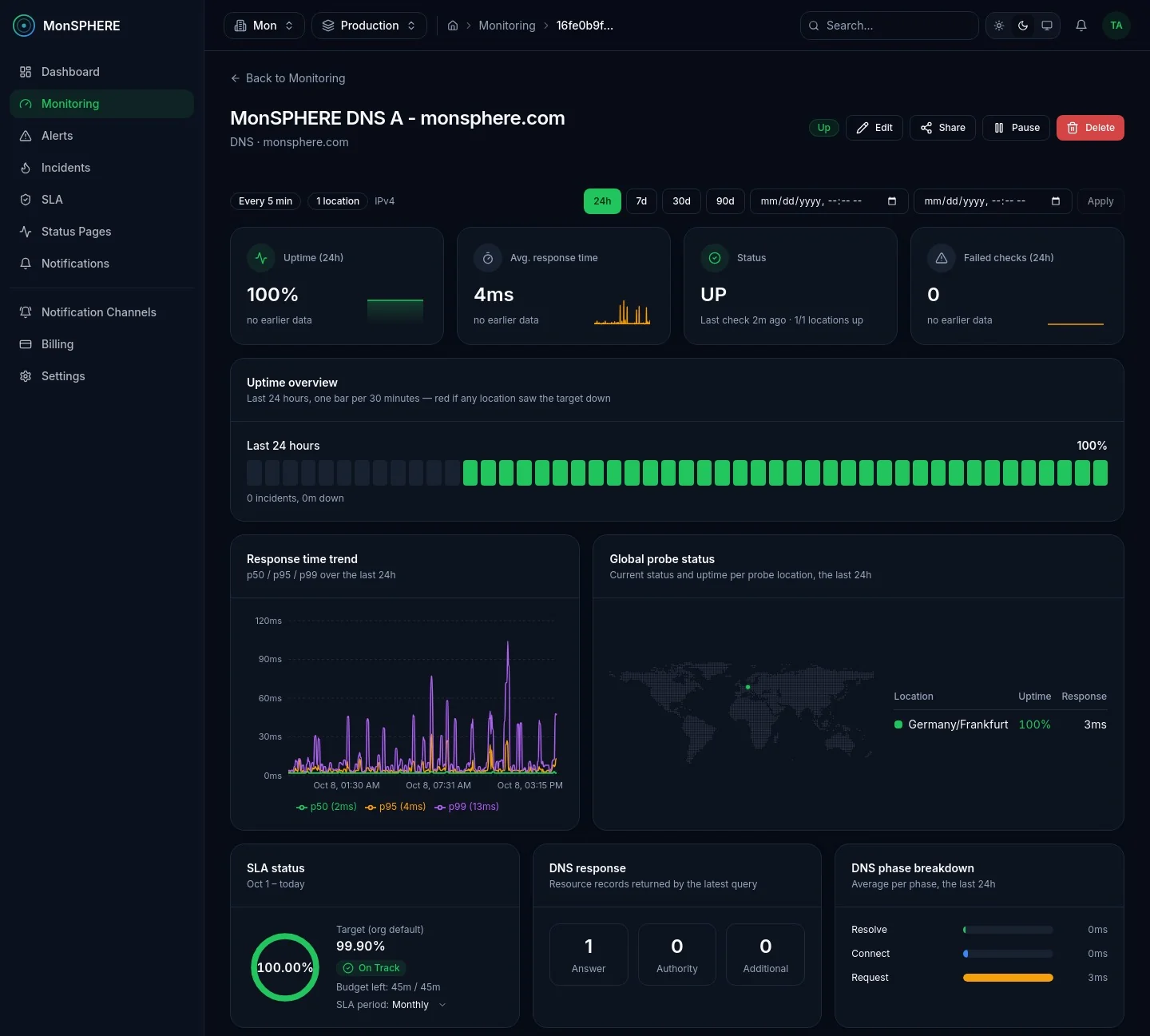
A DNS monitor resolves a name against a public resolver from each region and can require the answer to contain specific values, so a hijacked or silently changed record is caught, not just a lookup failure.
What it detects
- A name that stops resolving
- Records that no longer match the values you expect
- Slow lookups
- Missing or changed SPF, DKIM and DMARC records (see Email Authentication)
How you're alerted
- Create an alert rule on the DNS result, or use a TXT expectation as an always-on check.
Notifications go to any of 8 channels — see notifications.
- Runs from
- Every probe region you assign — down only when all of them agree
- Record types
- A, AAAA, CNAME, MX, TXT and NS, with expected values
- Dashboard
- Uptime, lookup time p50/p95/p99, answer / authority / additional record counts and the resolve–connect–request phase breakdown
- Available on
- Free, Professional · Enterprise and Custom on request
More in Uptime & APIs
View categoryWebsite Monitoring
Track uptime, response time, and page performance from every region you assign.
Advanced Website Monitoring
Regex assertions, forbidden keywords, and custom request headers and bodies — check what a page or API actually returns, including authenticated endpoints.
Ping Monitoring
ICMP checks for raw network reachability and latency tracking.
TCP Monitoring
Check that a host's port accepts connections, with connect time tracked from every region you assign.
Advanced TCP Monitoring
TCP over TLS plus send/expect validation — confirm a service actually answers correctly, not just that its port is open.
Cron Job Monitoring
Inbound 'I'm alive' checks for cron jobs and background workers — alerts when a run goes missing, with every ping and each run's duration kept.
API Transaction Monitoring
Chain multiple HTTP requests — extract a value from one response, like a login token, and reuse it in the next.
Synthetic Monitoring
Script a real multi-step browser journey — navigate, click, fill, wait, and assert — for user-flow monitoring beyond a simple uptime check.
Start monitoring everything in minutes
Create a free account, add your first check and get alerted the moment something breaks — no credit card required.